Nanjing University expands dialogue with Global South
A+ / A-
How can universities help make technological advances more widely accessible? How can the humanities maintain their relevance in an increasingly digital world? And what does it take to turn international academic partnerships into lasting cooperation?
Journalists and student representatives from 26 countries explored these questions in a dialogue with Tan Tieniu, chair of the Nanjing University CPC Council and an academician of the Chinese Academy of Sciences, held at Nanjing University in Jiangsu province on Oct 20.
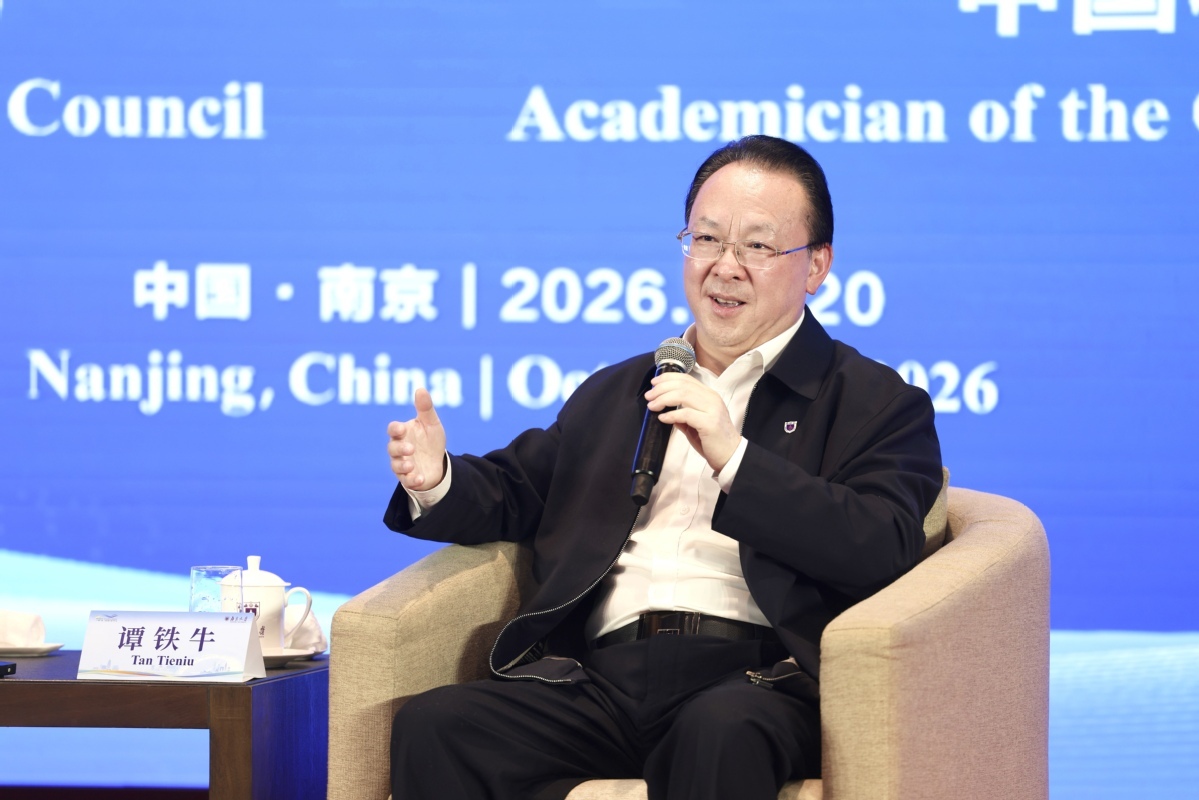
TAN Tieniu
"There is concern that AI could widen the gap between countries that develop advanced technologies like China and those that lack computing, infrastructure funding and skills for research," said Gordon Luandrow, a journalist from Namibia.
His question highlighted a challenge facing the Global South: how to ensure that technological progress creates opportunities for more countries rather than allowing existing gaps to widen.
In response, Tan pointed to China's progress in AI research and application, particularly its open-source large language models.
"We have made strong progress in AI research and application," he said, noting that Chinese models rank among the most widely used open-source models, which could help make AI technology more accessible internationally.
Tan also pointed to the establishment of the World Artificial Intelligence Cooperation Organization as part of efforts to promote international collaboration on AI.
"We are ready to work with countries across the Global South to train the next generation," Tan said, adding that the aim was to help young people "master essential AI skills".
The discussion then shifted to the impact of technological change on the humanities.
Catalina Camano Amato, a philosopher from Argentina, asked what technological change could mean for the humanities.
Tan argued that advances in AI have not diminished the importance of disciplines such as philosophy.
"If you compare human intelligence with AI, one major difference can be seen in fields such as philosophy, which require deep thinking — something today's AI still struggles with," he said.
The exchange raised a broader question about the respective roles of technology and human thought.
As universities embrace new technologies, the humanities continue to offer a space to examine the ethical, cultural and social questions that accompany technological change.
For many participants, the dialogue was also an opportunity to explore concrete pathways for deeper educational cooperation.
Cambodian journalist Chedna Teyte asked about links between Nanjing University and Cambodian universities.
Tan highlighted ongoing cooperation in cultural heritage preservation. He also outlined plans under consideration for science and education centers in the region that could provide preparatory courses, including Chinese-language instruction.
"We hope to build stronger ties with universities in Cambodia," he said.
Teresa Monteiro Pinto and Joseph Mbeng Boum, participants from Cabo Verde and Cameroon, also expressed interest in university partnerships.
Tan spoke about the value of direct interaction in building academic partnerships.
"Online communication makes it easier than ever to connect, but nothing can fully replace meeting face to face," he said.
Tan added that Nanjing University had been active in international academic cooperation, with initiatives supporting visits by international scholars to China and opportunities for Chinese scholars to work abroad, as well as scholarships and student exchanges.
One example was the Global Research Immersion Program for Young Scientists. Successful applicants can spend up to eight weeks at Nanjing University and other leading universities in the region, gaining firsthand experience of campus life and interacting with Chinese students.
Tan stressed that exchanges involving faculty members, researchers and students are important for building lasting relationships between universities.
The event marked the launch of the "Dialogue between University Party Secretary/President and Overseas Media" series, jointly initiated by the All-China Journalists Association and Nanjing University. More than 60 participants, many of them attending the Global South Journalists Workshop, explored how Chinese universities are responding to global challenges and expanding international cooperation.
The dialogue offered a glimpse of how such partnerships can begin: with questions, shared concerns and a willingness to learn from one another.
Tan concluded by citing an African proverb: "If you want to go fast, go alone. If you want to go far, go together."

Copyright © 2002 - Chinese Academy of Sciences
 15 Zhongguancunbeiyitiao Ave., Haidian District, Beijing 100190, China
 86-10-5935-8373(O) 5935-8300(Fax)


 中文


 中文


