Chinese Ecologist MA Keping Elected UNESCO MAB Council Chair
A+ / A-
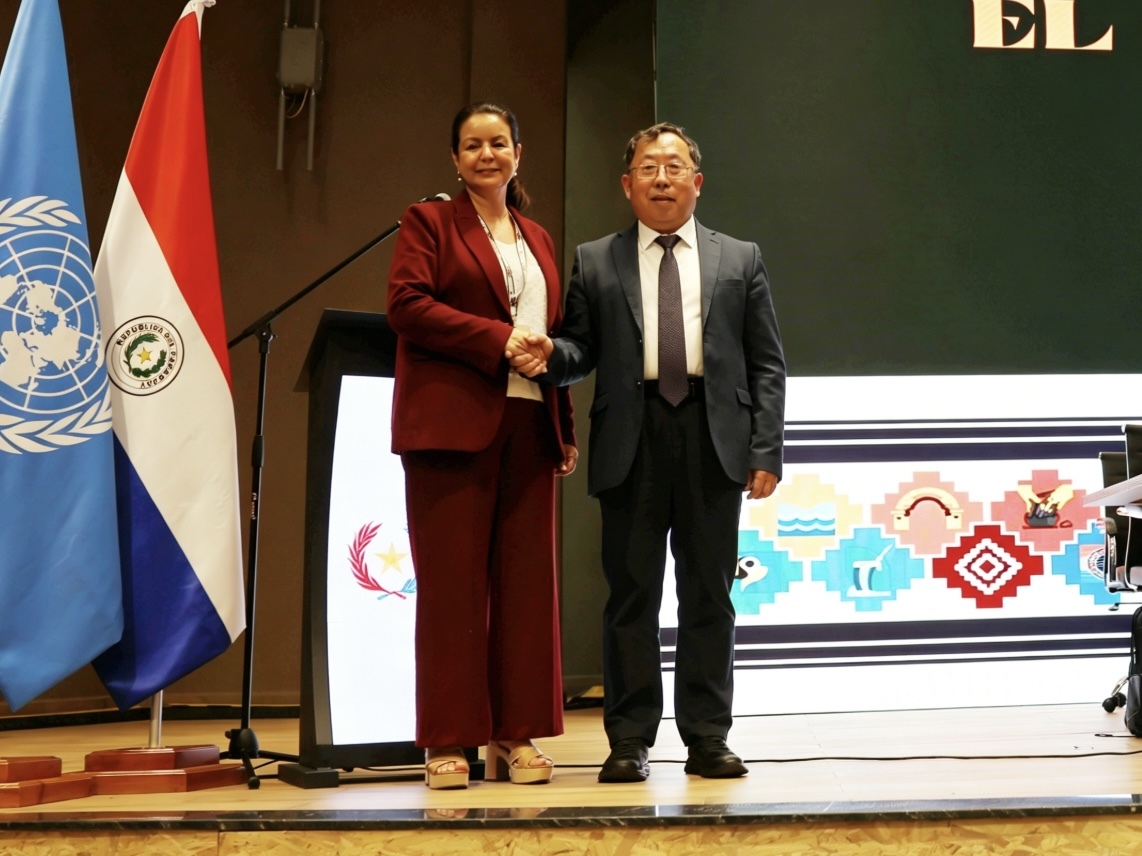
Academician Ma Keping (right) and outgoing Chair Latifa Yaakoubi complete a formal handover ceremony after Ma was elected Chair of the MAB-ICC Executive Board in Paraguay on Wednesday. [Photo provided to chinadaily.com.cn]
Chinese ecologist MA Keping has been elected chair of the top governing body of UNESCO's Man and the Biosphere Programme, becoming the second Chinese scientist to hold the position.
The vote took place Thursday Beijing time during the 38th session of the MAB International Coordinating Council, held in Hernandarias, Paraguay. MA, an academician of the Chinese Academy of Sciences and a researcher at the CAS Institute of Botany, will serve a term from 2026 to 2028.
The appointment comes 36 years after Chinese ecologist LI Wenhua, an academician of the Chinese Academy of Engineering, led the council from 1988 to 1990, and follows MA's role in shaping the program's strategic direction.
At UNESCO's invitation, MA led the drafting of the MAB Programme and Its World Network of Biosphere Reserves Hangzhou Strategic Action Plan (2026-35). The document, adopted at the 5th World Congress of Biosphere Reserves in Hangzhou last September, sets out a 10-year roadmap for global biosphere development.
Outlining his agenda, MA said his tenure would focus on building global consensus and strengthening science-based conservation across the MAB network. Key priorities include reinforcing biodiversity monitoring within the World Network of Biosphere Reserves and evaluating the network's effectiveness, measures he described as essential to building a more resilient and dynamic biosphere.
Launched in 1971, the MAB Programme is an intergovernmental scientific initiative aimed at reconciling biodiversity conservation with the sustainable use of natural resources. Its World Network of Biosphere Reserves now spans 784 sites across 142 countries, serving as living laboratories where communities test approaches to balancing human activity with ecosystem protection.
China joined the MAB Programme in 1973. Over five decades, it has evolved from an early participant into an active contributor. The country now hosts 36 UNESCO-designated biosphere reserves, and the successful hosting of the Hangzhou congress — the first time the event was held in Asia — underscored its growing influence in shaping the program's future.
MA's election reflects international recognition of Chinese scientific leadership and the country's deepening engagement in global environmental governance. China has signaled it will continue to leverage platforms such as the World Network of Biosphere Reserves to contribute expertise and solutions to biodiversity conservation and sustainable development worldwide. (chinadaily.com.cn)
Copyright © 2002 - Chinese Academy of Sciences
 15 Zhongguancunbeiyitiao Ave., Haidian District, Beijing 100190, China
 86-10-5935-8373(O) 5935-8300(Fax)


 中文
中文

 中文
中文


