Cryo-EM Structure Reveals How Topoisomerase Captures Transport DNA
A+ / A-
A research team led by Prof. RAO Zihe at the Institute of Biophysics of the Chinese Academy of Sciences has reported the first cryo-electron microscopy (cryo-EM) structure of a type II DNA topoisomerase directly bound to its transport-segment DNA (T-DNA). Published in Science Advances on December 18, the study provides direct structural evidence for how these essential enzymes capture and transport DNA during their catalytic cycle.
Type II DNA topoisomerases are essential for maintaining chromosome topology. They transiently cleave a "gate-segment DNA" (G-DNA) to allow the passage of another DNA duplex known as "transport-segment DNA" (T-DNA). This process resolves supercoils and entanglements generated during replication, transcription, and chromosome segregation. Despite their central role, however, direct structural evidence for how T-DNA is captured and transported has long been lacking.
Using the T4 bacteriophage type II topoisomerase as a model system, the researchers uncovered a previously unknown intermediate structural state in the catalytic cycle, offering important insights into the complete functional mechanism of the enzyme.
Through cryo-EM analysis, the researchers resolved, at near-3 Å resolution, the three-dimensional structure of T-DNA stably captured within the central cavity of the enzyme under near-native solution conditions.
Notably, the observed conformation differs markedly from the canonical G-DNA-bound state, instead resembling the apo form. Moreover, weak electron density consistent with loosely bound G-DNA suggests that this conformation may arise after G-DNA cleavage and religation.
Based on these structural features, the researchers proposed that the enzyme slides along religated, but not yet released G-DNA to facilitate efficient, processive catalysis.
Further mutational analyses showed that the Arg375 residue in the C-gate is critical for T-DNA transport. Alterations in its charge substantially impair DNA relaxation activity, indicating that the C-gate may be a promising target for designing future topoisomerase inhibitors.
This work provides a crucial structural foundation for elucidating the full catalytic cycle of type II DNA topoisomerases and opens new avenues for developing antimicrobial and anticancer agents that specifically target the T-DNA transport process.
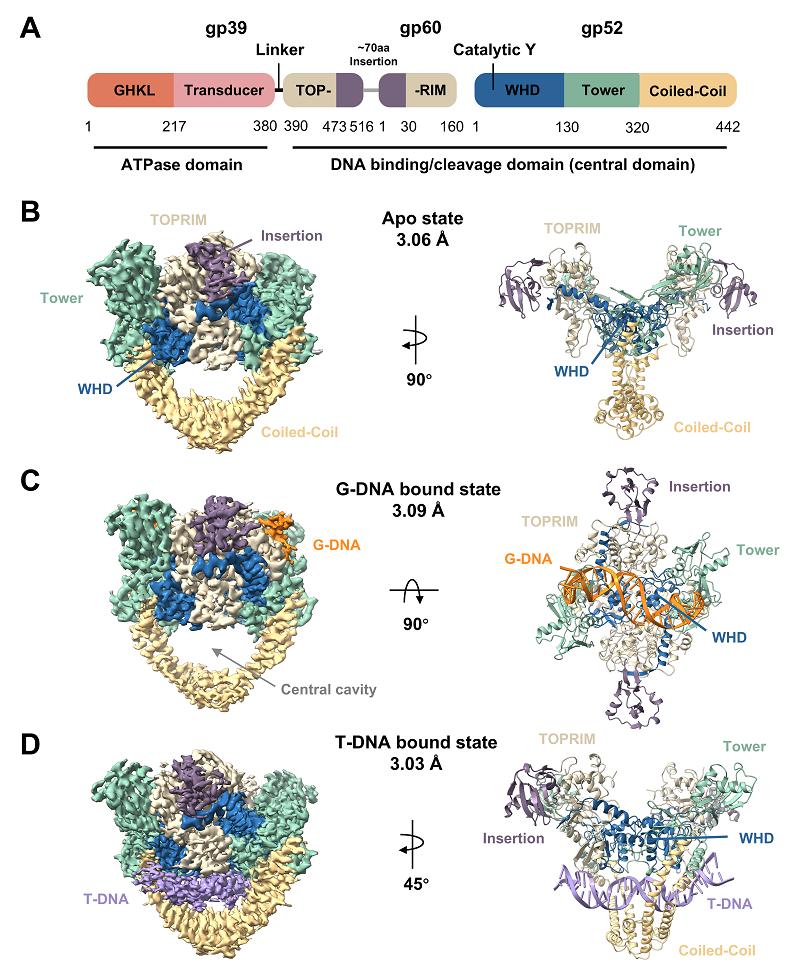
Cryo-EM structures of the central domain of T4 phage type II DNA topoisomerase in its Apo state, bound to gate-segment DNA, and bound to transport-segment DNA (Image by RAO Zihe's group)

Copyright © 2002 - Chinese Academy of Sciences
 15 Zhongguancunbeiyitiao Ave., Haidian District, Beijing 100190, China
 86-10-5935-8373(O) 5935-8300(Fax)


 中文
中文

 中文
中文


